Turn Prime Day from a short revenue spike into a repeat-purchase growth engine.
A focused strategy sprint to review last year’s performance and design this year’s lead-in, Prime Day event, and post-event retention strategy.
Includes:
• Your 2025 Prime Day performance analysis + insights
• 90-minute strategy workshop
• Prime Day growth playbook
• Walkthrough session
Investment: $5,000
Optional Add-on offerings:
Execution Readiness Map (Assets + ownership + detailed timeline)…..$2,000
Post-Prime Day Measurement Review………$2,000
Amazon Prime Day
NEW!
Growth Planning Sprint
The Prime Day trap most brands fall into
Most brands approach Prime Day tactically.
They plan discounts, ads, and inventory but rarely step back to design the growth strategy around the event.
That often leads to:
Prime Day ads reaching cold audiences at peak CPMs — paying a premium for attention you haven't earned yet
A revenue spike that doesn't compound
New customers who never come back
Teams scrambling across Amazon, social, and influencer with no coordinated story
No clear way to measure what actually worked so next year, you start from scratch
A better way to plan the event
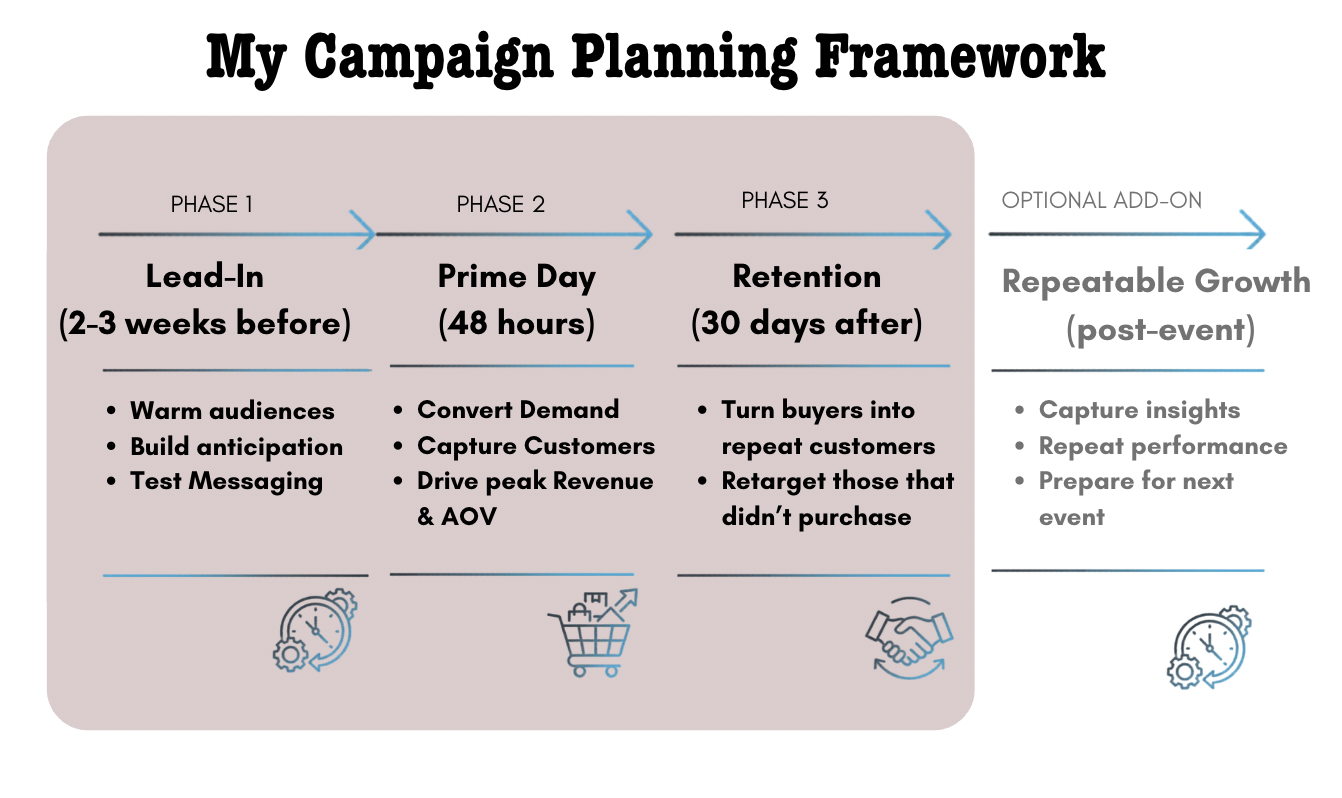
The brands that get the most out of Prime Day treat it as a full growth moment — with a lead-in strategy, a focused event plan, and a retention approach.
By the end of the sprint, you’ll have:
A clear role for Prime Day in your broader growth strategy
A lead-in plan that warms buyers before you spend a dollar on Prime Day ads
An event plan where every channel has a clear role and a clear metric
A retention sequence built before the event starts — not scrambled together after
A simple way to measure what worked so you can repeat it
The Sprint Timeline
Step 1
Learn from Last Year
We start by reviewing last year’s Prime Day results to uncover the insights that should shape this year’s strategy.
Step 2
Align on Strategy
In a structured working session, we define the role Prime Day should play and identify the highest-impact opportunities.
Step 3
Design the Growth Playbook
You receive a clear plan outlining the lead-in strategy, event execution, retention approach, and measurement framework.
Step 4
Leave with Clear Action Plan
We walk through the final plan together so your team knows exactly what to prioritize and how to execute.
Frequently Asked Questions
-
While Amazon has not officially announced the 2026 Prime Day dates, reports suggest the event may shift from July to late June, which would make planning timelines even tighter for many brands.
2025’s dates: July 8-11
2024’s dates: Jul 16 - Jul 17
-
Not at all. The most effective Prime Day strategies are designed ~8-12 weeks before the event, while there’s still time to create assets, test messaging, and coordinate teams. This sprint helps brands get ahead of the last-minute scramble.
-
Good — this sprint is designed to work with your team, not replace them. Most Amazon teams are excellent at executing on-platform: ads, listings, inventory, promotions. What this sprint addresses is the strategic layer that typically falls in the gap between teams — the cross-channel lead-in, the coordinated event story, and the post-event retention sequence that nobody fully owns. Your team leaves with a playbook that makes their execution sharper, not a consultant who takes over.
-
That depends on your brand, your volume, and your starting point — and anyone who gives you a guaranteed number before seeing your data isn't being straight with you.
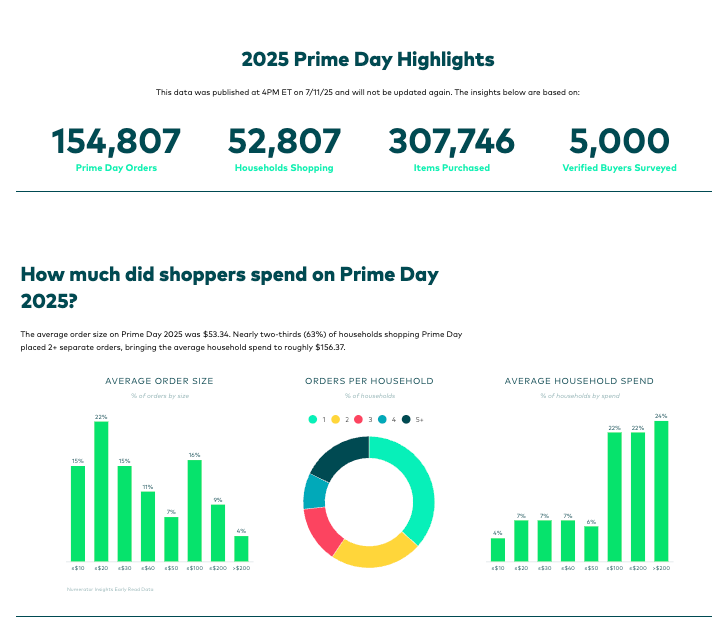
What's worth keeping in mind is the size of the opportunity. The average Prime Day household spent $156 across multiple orders. Nearly two-thirds of shoppers placed 2 or more separate orders during the event.
For consumer CPG brands, Prime Day is often one of the largest revenue moments of the year — which means even small strategic improvements can have an outsized impact on the numbers that matter.
The sprint doesn't add more marketing activity on top of what you're already doing. It helps ensure the effort and budget you're already committing to Prime Day is focused on the plays most likely to drive results:
— Stronger demand coming into the event, so your ad spend works harder
— Higher-converting offers or bundles that protect margin
— A retention sequence that turns Prime Day buyers into repeat customers over the 30 days after
— A clear read on what worked, so you're not starting from scratch next year
The brands that get the most out of Prime Day aren't necessarily spending more. They're making smarter decisions about where to focus — before, during, and after the event.
-
Very little. The core commitment is a 90-minute working session. Everything else happens before and after the session, including the post-mortem review and creation of the Prime Day playbook.
-
That's worth exploring before assuming. For most consumer CPG brands — especially in beauty, health, wellness, household essentials, and personal care — Prime Day is one of the highest-intent purchase windows of the year. Many brands underperform it not because the demand isn't there, but because they've approached it as a one-channel promotion rather than a full growth moment.
If your brand has historically seen modest Prime Day results, that's often a signal the strategy needs rethinking — not that the opportunity isn't there.
That said, this sprint is best suited for brands where Amazon is already a meaningful channel and Prime Day is at least on the radar. If that's not where you are yet, this probably isn't the right fit — and I'd rather tell you that upfront than have you invest in something that doesn't match your situation.
-
This sprint focuses on strategy and planning. Execution can be handled by your internal team or existing partners. If additional support is needed afterward, we can discuss follow-on options.
-
That’s completely fine. If you have prior Prime Day results, we’ll review them. If not, we can still work from recent promotions, product performance, and internal observations to shape a stronger plan for this year.
-
That’s actually the ideal starting point. Most teams already have ideas — the value of the sprint is prioritizing the right ones, structuring them into a clear plan, and connecting the lead-in, event, and retention strategy so they work together.